Key Technical Parameters and Impact
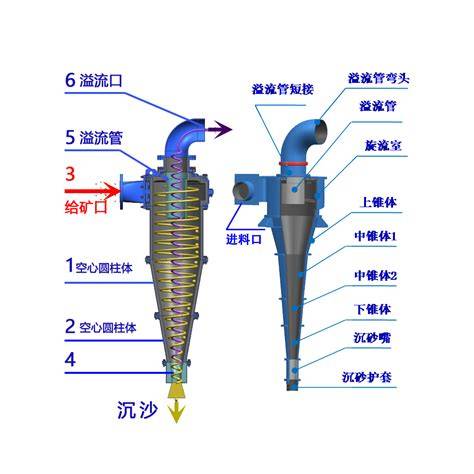
Diameter (D): determines the treatment capacity (the larger the diameter, the higher the treatment capacity, such as D = 300mm hydrocyclone treatment capacity of about 50-100m³/h).
Cone angle: common 15 ° - 20 °, cone angle small separation precision, cone angle large processing efficiency.
Inlet pressure: usually 0.1-0.5MPa, the higher the pressure, the greater the intensity of the cyclone, the better the separation effect, but also higher energy consumption.
Diversion ratio: overflow flow / inlet flow, affecting the separation of particle size (such as coal slurry classification diversion ratio control in 30% -50%).
Selection and maintenance points
Selection according to the separation target:
Solid-liquid classification (such as slurry): choose hydrocyclone, according to the requirements of the particle size (such as separation size of 5-50μm) to choose the diameter and cone angle;
Mineral sorting: choose the heavy media cyclone, with the density of the media (such as coal with the density of the heavy media 1.3-1.8kg / L).
Maintenance recommendations:
Regularly check the wear and tear (underflow mouth, cone section of the inner wall is easy to wear, can be used polyurethane or ceramic lining);
Avoid mixing metal impurities in the overflow material, to prevent clogging or damage to the equipment;
corrosive media processing, the use of 316 stainless steel or rubber-lined material cyclone.
Typical application cases
Coal mine washing: heavy media cyclone separates the raw coal according to the density, fine coal is discharged from the overflow port, and gangue is discharged from the underflow port, and the sorting efficiency reaches more than 95%.
Sewage treatment: hydrocyclone thickening activated sludge, sludge concentration from 0.5% to 3%-5%, reduce the subsequent dewatering equipment load.